
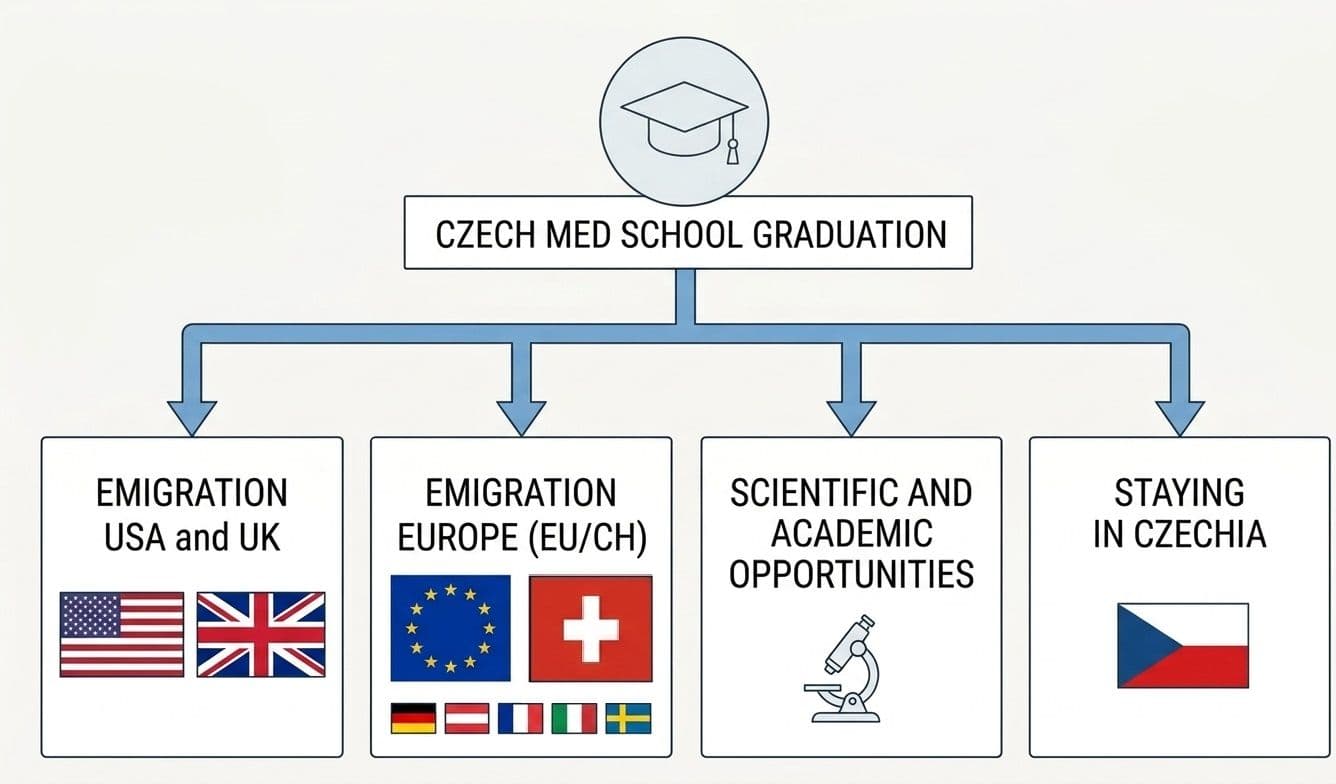
So you have worked hard and smart, and after 6 years you are holding that tube with a diploma in Latin. You are an MD. This itself can be overwhelming, so it's reasonable to plan a bit forward. Let's talk a bit about the most common ways the Czech medicine faculty alumni choose to go.
1) Emigration
The first option is emigration right after graduation, and this is the most common decision. Some graduates return to their home countries. Diploma recognition depends on the country, and recognition agreements vary internationally.
Within the European Union, diploma recognition is automatic.
For many graduates, the most attractive option is moving to wealthier healthcare systems in Western countries. The most common destinations include the United States and Great Britain, and Germany and Austria.
Emigration after board certification in Czechia is more reasonable for countries with complicated residencies and paths to board certification.
a) USA and UK
This is a less common pathway. Practicing in the United States has always required diploma recognition and passing the USMLE examinations; after Brexit, the same situation is with the UK (UKMLA). Both countries offer significantly higher salaries and excellent career opportunities, but the process of getting there is considerably more demanding. That is why most of the alumni choose EU as a more accessible option. Some Czech faculties, though, directly assist in diploma recognition and taking the Step 1 USMLE. Acquiring board certification in Czechia is impractical in the case of this countries, because it can be accepted only partially in this countries.
b) European Union
EU countries recognize Czech medical diplomas automatically. However, language proficiency is still required, usually between B2 and C1 depending on the country. Many students begin learning additional languages during medical school by choosing language electives.
Germany, for example, offers salaries approximately 1.2–2x higher than Czech salaries while maintaining a relatively comparable cost of living. The country is very multicultural, and some hospitals reportedly employ up to 80% Czech medical graduates. Residencies are non-competitive, and to become a board-certified doctor an alumni needs ~6 years and a completed checklist of procedures performed.
You can see the case of Alireza, who studied the 3rd Faculty of Medicine of the Charles University in Prague and now is a neurosurgeon in Germany.
Austria offers a bit lower salaries than Germany, but in turn provides doctors a bit more stable economy to work in; it is mostly similar to Germany, though. The country is known for its safety and natural beauties. A conservative choice.
You can also think about France, that offers salaries 1.5-2x higher than Czech Republic. Residencies here, however, are competitive and require passing additional examinations.
If you are a fan of dolce vita, Italy may be your choice; although economically less attractive (salaries 1.1-1.3x compared to Czechia), it's a cultural and existential choice mostly. The healthcare system is rigid, and residencies are competitive.
Sweden boasts with a very well structured residency program, that allows the young doctor to become truly knowledgeable in the chosen specialty. The healthcare system is non-hierarchic by its nature. The salaries are up to 3x higher than in Czechia, but you have to take progressive tax in account and higher costs of living.
c) Switzerland
Switzerland recognizes the Czech medical diploma automatically; although, depending on your citizenship, it can take more or less time in MEBEKO (Medical Professions Commission). Czech board certification is recognized.
Switzerland is sometimes percepted as an Eden garden because of its riches (up to 4-5x higher salaries than in Czechia), but the truth is that the country has some problems - including extremely high costs of living, bureaucracy and a very conservative closed culture. It is not easy to get into the system without any experience; the Swiss prefer doctors, who have practiced in a German-speaking country before.
Check out our short interview with a Swiss student of the 3rd Faculty of Medicine of the Charles University.
2) Staying in Czechia
Practicing medicine requires Czech language proficiency, officially usually at least B2, though B1 may function practically in certain environments initially. Remaining in Czechia is often the more secure and predictable option, also due to noncompetitive nature of residency. The most prominent hospitals offer a limited number of resident places, it is true, and prefer board certified doctors. But if you don’t get there, there is always a possibility to find a resident place in another faculty or a regional hospital that offers good conditions.
Specialization training is divided into two major phases: the 1st phase lasts approximately 3 years and includes rotations through related specialties, the 2nd phase lasts approximately 2 additional years and focuses more specifically on the chosen specialty. Czechia experiences chronic shortages of doctors in allergology, child and adolescent psychiatry, child and adolescent neurology, endocrinology, oncology and pediatrics.
You can learn more about Czech healthcare system and its culture in our other article.
A junior doctor after graduation in 2026 earns approximately 1850 EUR gross monthly. A young doctor in the first stage of attestation earns around 2160 EUR, while a board-certified physician earns approximately 2410 EUR under standard hospital tariffs.
At first glance these salaries may not appear particularly high, but they represent only the basic hospital pay. Doctors commonly receive personal bonuses of up to 500 EUR monthly, significantly increased pay for shift work, and night or emergency shifts that may be paid at two to three times the normal hourly rate. Shift work alone can sometimes increase monthly income by up to 1500 EUR.
As a result, a board-certified physician working in a hospital may realistically earn up to approximately 4000 EUR net monthly after taxes. In the private sector, income ceilings are much higher and depend heavily on specialty. In some fields, monthly income can easily reach 8000–10000 EUR.
This begins to look considerably more attractive when compared with the approximate monthly cost of living: around 1500 EUR/month in Prague, and significantly lower in smaller cities.
3) Scientific and Academic Opportunities
Faculty hospitals in Czechia offer meaningful scientific and academic opportunities, especially for students who become integrated into departments early. Advantages of faculty hospitals include easier access to research teams, closer mentorship relationships, and a lower barrier to entering PhD programs.
A Czech PhD in medicine can significantly strengthen international academic and clinical career opportunities, but doing a PhD is not easy and has to be a strategic choice. This was one of the reasons why our founder Sergei started his research in repetitive transcranial magnetic stimulation.
Conclusion
Czechia offers a solid medical education with an exceptionally strong theoretical basis combined with good clinical exposure, but the main strength of a Czech medical degree is in the range of options it opens after graduation. The straightforward international pathway is to move to another EU country, particularly Germany or Austria, where Czech medical diplomas are recognized and the European labor market is accessible. Beyond the EU, the degree remains a valuable and recognized qualification, although additional licensing requirements may apply.
For students interested in research, Czech medical faculties and teaching hospitals also provide a pathway into PhD programs and an international academic career. Finally, students can stay in Czechia and build a medical career within the local healthcare system, with a relatively predictable path into specialization.
Success depends on initiative, discipline, and adaptability. Actively seeking clinical experience, building relationships within hospitals, and understanding how the local healthcare system works can make a substantial difference to the opportunities available after graduation.
Ready to study medicine in Czechia?
A Czech medical degree can open doors across Europe and beyond — but getting there starts with getting into medical school. MedCzech helps international students prepare for Czech medical school entrance exams and understand what it takes to succeed once they get admitted.
Apply for our program now!