
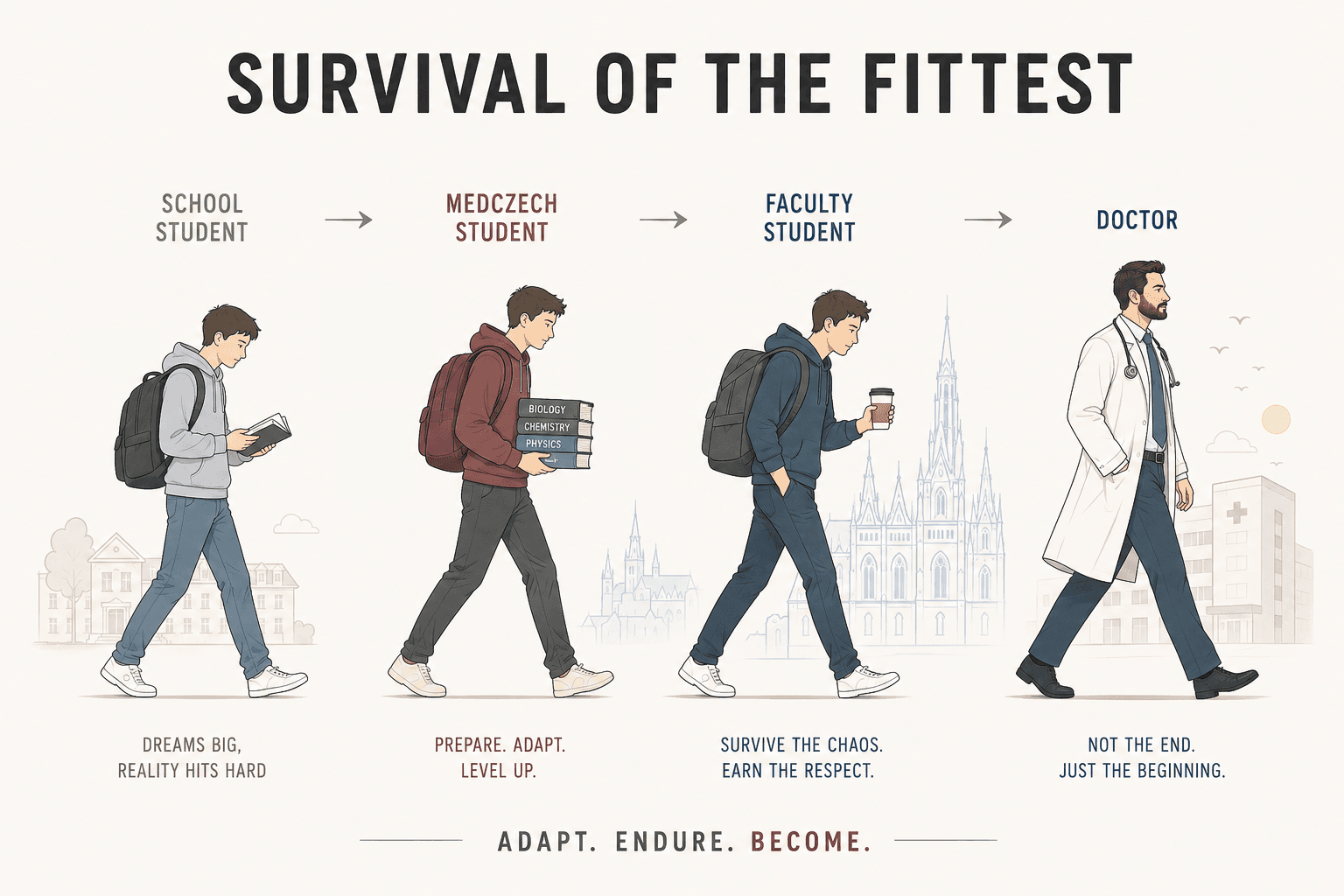
Studying medicine in Czechia is a demanding path. Medical faculty is a competitive environment filled with highly motivated people, and not everyone makes it to graduation.What the system asks for is discipline, resilience, and a certain degree of self-denial, and you should not expect constant accommodation. But in return you receive a real higher education, that you can be proud of— not an imitation of one.
Structure of Medical Education in Czechia
The exact organization depends somewhat on the faculty, but the general idea is similar everywhere. Students attend many practical seminars with real clinicians, while lectures are often taught by leading specialists in their fields. Lectures are usually not compulsory, but it’s important to visit them, especially during the first years.
1st year
After the ritual of “immatriculation”, starts the year of struggles, which is dominated by Anatomy (and Dissections) and Histology. The amount of information is enormous, and it needs constant revising and memorization. On top of that, you get minors like Latin, Genetics and Biophysics. This is the year where most dropouts happen.
2nd year
The second year focuses mainly on Physiology and Biochemistry. These subjects are logical, “cleaner” than anatomy,but still heavily demanding. At this stage, students begin hearing the word “colleague” more frequently when addressed by teachers. Clinical practice also begins, and students can finally find some time for electives.
One important exception is the 3rd Faculty of Medicine, where Anatomy, Histology, Physiology and Biochemistry are taught in parallel from the 1st year and culminate in a massive integrated exam at the end of the 2nd year.
Elective Subjects
Electives are one of the few places where the system becomes flexible. You can choose from a myriad options like Scientific Writing, Advanced Cell Biology,Tropical Medicine and Parasitology, Introduction to Psychotherapy, or practical surgical courses including Plastic Surgery. On the humanities side, there are courses like Philosophy, Religious Studies, languages,and History.
Students have access to the Charles University Sport Center, where courseslike Swimming or Fencing are offered. Some programmes even allow you to gain a professional diploma of a sports instructor or lifeguard (or masseur),which can be used to earn some money – all for a low price.
3rd year
The third year revolves around Pathology. Again, the information load is heavy. Other important subjects like Pathophysiology and Pharmacology may interest you more, and finally, you get introduced to the basics of internal medicine and surgery. This is also the time to look for a supervisor if you are interested in beginning scientific work and participating in student scientific conferences.
Clinical Years
After the third year, studies generally become more manageable. Teaching moves into clinical blocks ending with exams. You rotate through departments, and slowly start noticing where your interests actually lie.
Approximate subject load in the 4th year is around 20 subjects, and in the 5th year around 15 subjects. By the end of the fourth year, fatigue accumulates. For many, the fifth year is the psychological peak of exhaustion and burnout.
6th Year and Graduation
The sixth year often passes surprisingly quickly. Students complete clinical rotations and prepare for state exams in Pediatrics, Surgery, Internal medicine and Hygiene/Epidemiology (and Neurosciences specifically at the Third Medical Faculty). Then suddenly it’s over – one day you’re stressing about exams, and shortly after you’re being ritualistically “promoted” and holding a European medical diploma and being called “doctor.”
Main Pitfalls
Academically, medicine is harsh, but manageable with appropriate systematic work. Sometimes, studying has to be chosen over social life, but these are temporary difficulties, although some would argue that a doctor must study throughout their entire life. As one of our cardiology professors used to say: “Colleagues, do not spend a single day without reading a professional paper.”
Still, the hardest aspect is not academic – for many international students, the shock is psychological. Many move straight after high school to a completely unfamiliar country, far from friends and family. Lonelinessand isolationcan become a serious problem, that can lead to depression, substance abuse, and loss of direction in those who fail to build stable routines and support systems. For many people, it takes 2-3 years to rebuild a reliable social circle and regain a sense of stability.
What Actually Matters
From the start, a few things make the difference:
- Psychological hygiene – explore your new environment, retain hobbies if possible
- Healthy lifestyle — sleep well, be physically active, eat healthy food
- Build supportive peer connections
- Study consistently and independently, study smart — and hard
- Avoid scattering your focus
Medicine is not a sprint, it is a psychological marathon. If you are seriously motivated, confident in your abilities, and prepared for seemingly endless hours of studying without immediate reward, Czech faculties can offer you an outstanding education at the oldest university in Central Europe. But the motivation itself is not enough.
Why MedCzech Exists
We went through this system ourselves, with our fair share of mistakes, and know how it works from the inside. We understand both the academic pressure and the psychological difficulties of adaptation. This is why we created MedCzech: we wish something like this had existed when we started.
What we provide is not only rigorous academic training, but also psychological preparation and mentoring. The students who adapt fastest are usually those who understand the system before arriving, and we give you the tools to survive through the first years.
Admission is not the end of the process, and we don’t leave you on your own once you get accepted — the community stays with you, as well as access to our advice and mentorship into the early years of study, when they are often needed the most.